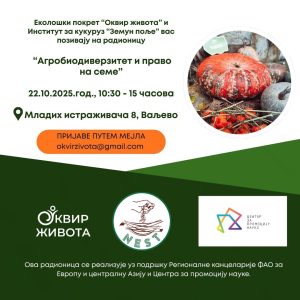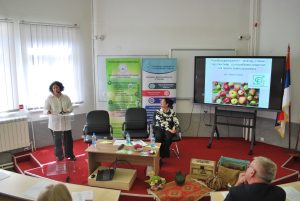
The workshop “Agrobiodiversity and the right to seeds” was held in Valjevo on October 22 at the Association of Young Researchers “Vladimir Mandić Manda”. It was carried out in cooperation with the Ecological Movement “Frame of Life” and the Maize Reserach “Zemun Polje”, through the citizen science project “NEST” (“Women Netting for Domestic Seed Treasure Revival”), funded by the Center for the Promotion of Science. The goal of the NEST project is to promote the sustainable cultivation of traditional varieties through civil scientific research, which is complementary to the work of “Frame of Life”.
The workshop is part of a project dedicated to strengthening the capacity of local communities to preserve biodiversity and traditional knowledge. As part of the project, a network for plant genetic resources is being formed, the goal of which is to gather all interested parties and approach the problem from the perspective of different groups of citizens.
The representative of “Frame of Life”, Dr. Ivana Radović, while presenting the work of this environmental movement, introduced the local community to the activities and opportunities for the involvement of citizens. In Valjevo, she also presented the initiative for the formation of a network for plant genetic resources, the initiator of which is “Frame of Life”.
Dr. Slađana Savić introduced the audience to an overview of the importance of plant genetic resources for food and agriculture, as well as the current state and prospects for the preservation of this important resource.
Biologist Predrag Peca Petrović gave his opinion on the ecological importance of old varieties, which are often neglected, but extremely important from the aspect of sustainable agriculture and agroecology.
On behalf of the “Zemun Polje” Maize Research Institute, Dr. Vojka Babić held a presentation “Conservation of old varieties of agricultural plants – the importance of civic initiatives for sustainable development and food security.”
From the presentation of Dr. Vesna Perić from the “Zemun Polje” Maize Institute, the attendees also heard an interesting positive example of practice – how old varieties were reintroduced to the market in Slovenia.
Dr. Aleksandar Radović from “Frame of Life” held the final presentation, the focus of which is the preservation of old fruit varieties – through practical aspects.
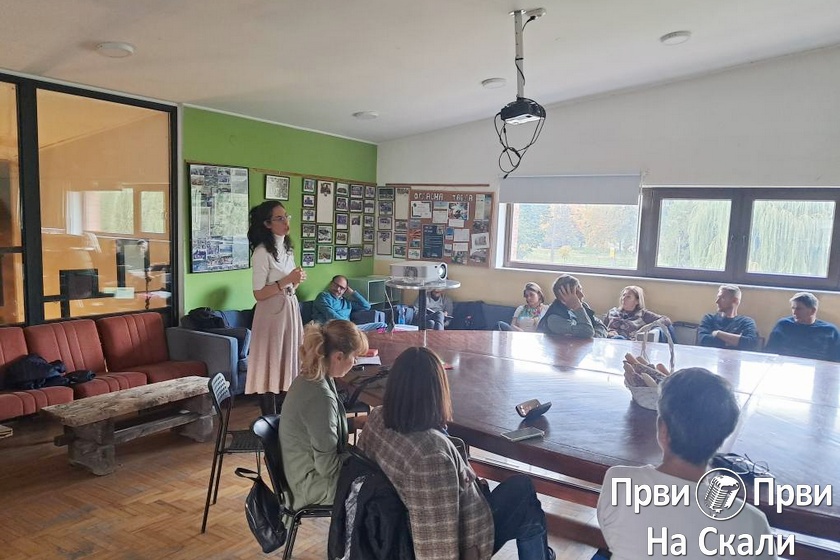
After this presentation, a discussion was opened.
- First of all, advice was exchanged in the field of fruit growing. Since the workshop was attended by numerous manufacturers, their problems in product placement were discussed, as well as various aspects of association. Gardening hobbyists highlighted their problems, such as cooperation with the local communities where they moved. The deterioration of product quality due to the desire for the highest possible profit while the production cannot keep up with the growth of demand, as well as the insufficient number of producers engaged in the production of old varieties, was highlighted. As in the workshop in Prokuplje, in Valjevo, a small number of old varieties that are on the variety lists were highlighted, which is why producers cannot use subsidies for them. The representative of the agricultural school from Valjevo suggested that the registration of old fruit varieties be resolved at the legislative level. It was agreed to hold regular online meetings where all interested parties can attend, to investigate the main problems in more detail, and to identify the causes, as well as to work together to solve them, Dr. Ivana Radović summarized.
The previous workshop was held in Prokuplje, in cooperation with the Toplica Academy of Practical Studies. The next one will be organized in Belgrade. The workshop in Valjevo is an integral part of two projects:
“Strengthening the capacity of local communities to preserve biodiversity and traditional knowledge” – Ecological movement “Frame of Life”, with the support of the FAO Regional Office for Europe and Central Asia (FAO REU), at the Food and Agriculture Organization of the United Nations agency.
“Women Netting for Domestic Seed Treasure Revival (NEST)” – Maize Institute “Zemun Polje”, with the support of the Center for the Promotion of Science
Author of the text: D.M.M.
Source: ПРВИ ПРВИ НА СКАЛИ